
How to play
Reading iCanPiano Style
iCanPiano Style is a way of writing piano music that helps you read fluently. If you can read piano music, you can read iCanPiano Style in a few minutes.
Eye-notes instead of sharps and flats
There are no sharp, flat or natural signs. Instead, a note on a black key is an Eye-note: a notehead that is half black and half white, like an eye looking left or right.
- Black spot on the right: a sharp.
- Black spot on the left: a flat.
Quarter, half and whole notes keep their usual shapes, so rhythm reads exactly as before.
White keys need nothing
If a notehead is not half black and half white, it is a white key. That is why there are no natural signs.
The note shows where it is on the keyboard
D sharp and E flat are the same black key. The black half of the Eye-note points to the black key next to the white note it is written on, so the picture in the music matches the picture under your hands.
Sharps and flats on white keys
C flat, F flat, E sharp and B sharp are played on white keys. There are two editions for them:
- Composer edition: the note keeps its original spelling, with an Eye-note looking up (flat) or down (sharp). Harmonically correct.
- Player edition: the note is written as the white key itself (F flat becomes E). Easier to play, though not the composer's spelling.
The key signature names the key
The key signature is still there, drawn with Eye-notes. It tells you the key; you never need it to work out a note, because every black key is already marked.
Try it
Read the same bars by J. S. Bach in standard notation and in iCanPiano Style.
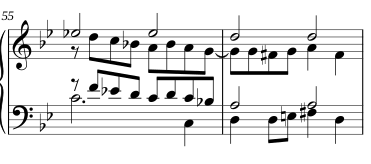
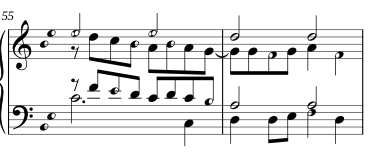
Why it works
In standard notation every note needs a second thought: is it in the key signature, did an accidental change it earlier in the bar? With two hands at once, that is slow and tiring.
The one thing a pianist always knows for sure is whether a key is black or white; you can even feel it under your fingers. Eye-notes show exactly that, right where you look.
When black keys stand out from white keys, reading gets faster and mistakes drop, from the first piece.